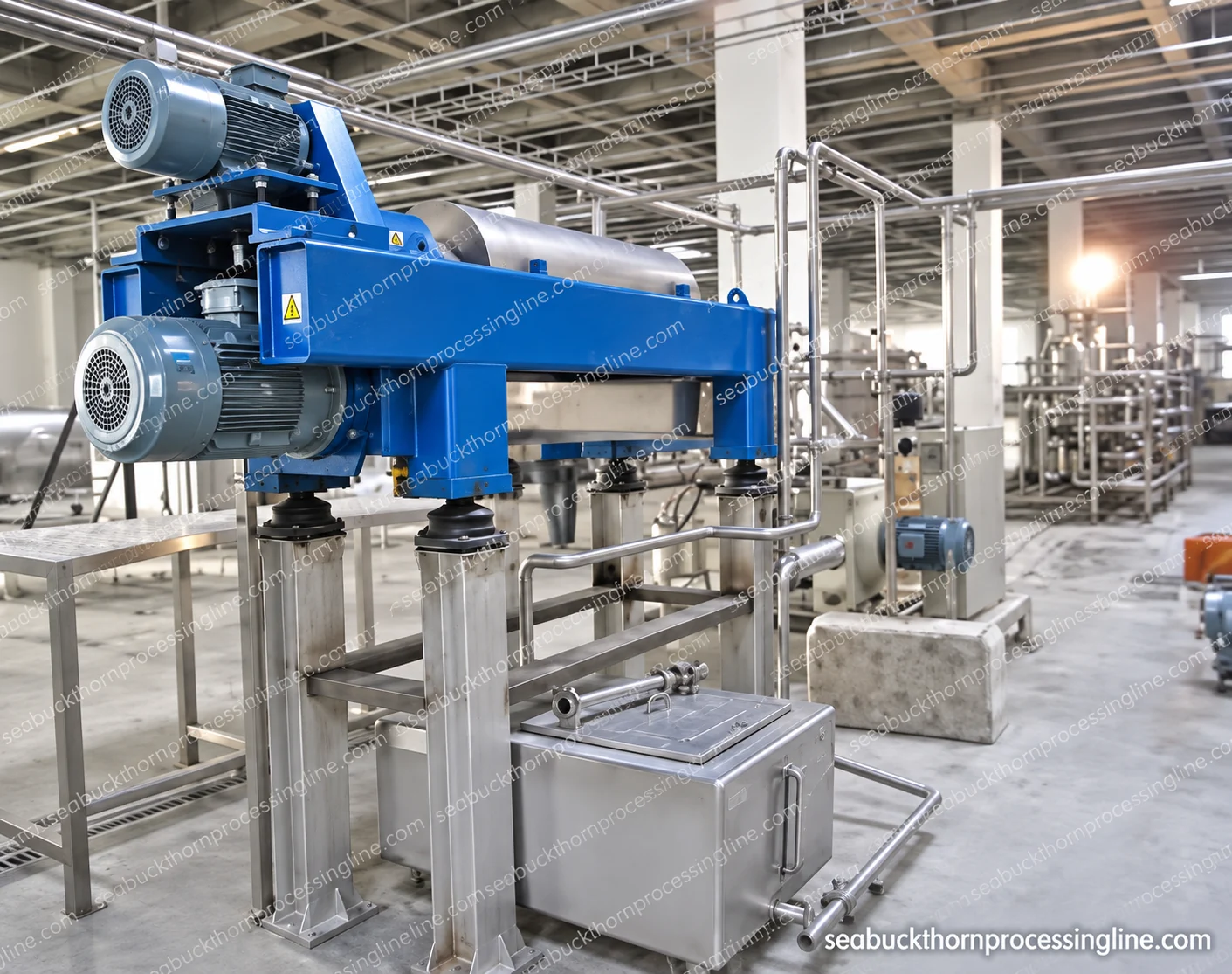
Separate particles without assuming every phase behaves alike
The bowl rotates while an internal scroll transports separated solids toward their discharge. The relative motion of bowl and scroll, feed condition and liquid level affect the solids movement and the character of the liquid leaving the machine.
Sea buckthorn contains suspended tissue as well as oil-bearing material. Removing sediment-forming particles does not prove that a stable emulsion will split or that an oil-rich product has been recovered. Specify the accepted liquid and reject as distinct streams before choosing settings.
Keep changes at the inlet visible
A buffer upstream can reduce sudden changes in flow and solids loading. Record product temperature and whether the stream came from pulping, pressing or enzyme conditioning. Each changes what reaches the decanter; the same pump flow does not make the feeds equivalent.
Foam and entrained air complicate consistent metering. Choose feed delivery around the actual viscosity and inlet requirement, with suitable instrumentation and a safe route for startup or off-specification material.
Agree a solids-removal duty
| Measurement | Use in selection | Interpretation |
|---|---|---|
| Feed mass and solids condition | Loading and pumping basis | Include temperature and preparation route |
| Accepted liquid turbidity or pulp content | Clarification endpoint | Choose the method appropriate to the final product |
| Wet reject mass and composition | Solids-discharge duty | Do not equate wet reject mass with dry solids |
| Liquid and reject samples after a defined hold | Phase behaviour | Distinguish sediment from an oil-rich cream layer |
Locate the decanter within the separation sequence
A disc separator may be evaluated after coarse solids removal when a finer clarification step is required. Adding both machines is not automatically necessary: the trial should identify which stage makes a useful change in the agreed product endpoint.
Provide service access for rotating assemblies and drive components, and specify the solids collection route alongside the product outlet. Cleaning must follow the selected machine configuration and operating instructions; a general CIP recipe cannot substitute for that sequence.
Further answers
Equipment and process questions
Does solid–liquid separation also recover a separate oil product?
The application described here separates settleable solids from liquid. Recovering an additional oil-rich fraction requires a specifically selected phase arrangement and a trial that measures each actual outlet; it is a separate duty from this solids split.
What rated flow is available for sea buckthorn?
A sea buckthorn rate must be set from the inlet condition and required solids split. No model, bowl speed or application-specific throughput is assigned from this photograph.