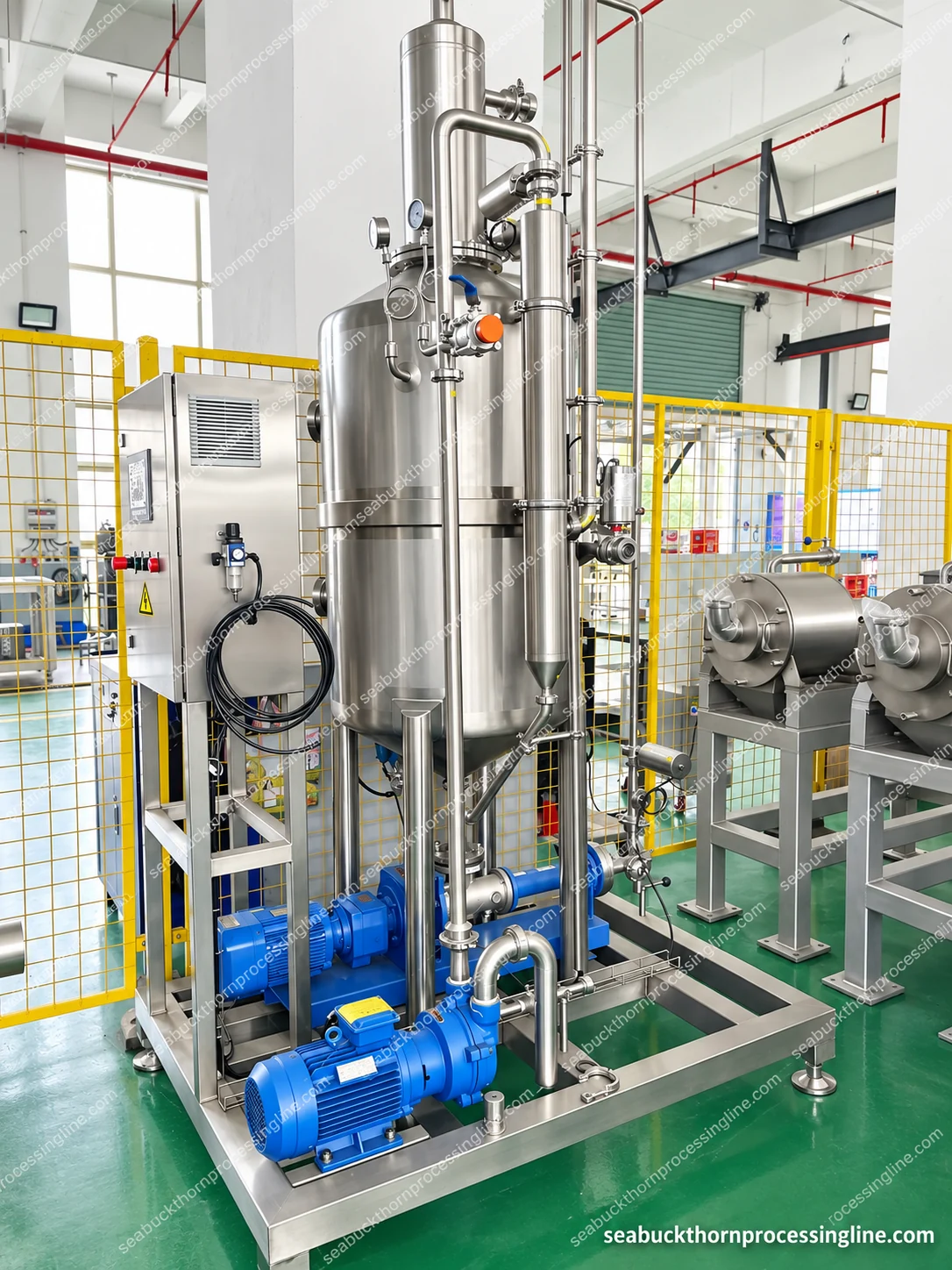
Define where the air enters and why it matters
Pulping, open transfers and poorly matched tank agitation can introduce air. Before selecting deaeration, identify the relevant air pickup and the point where removal would help. Correcting an avoidable leak or splash at transfer may also improve the inlet condition.
Vacuum level, product temperature, exposed surface and residence interact. These conditions need to suit the viscosity and foaming tendency of the sea buckthorn stream. There is no fixed oxygen endpoint or nutrient-retention percentage assigned to this unit.
Keep product out of the vacuum service
Foam can occupy vessel space and carry material into the vapour path. The selected arrangement needs a stable liquid level and a clear response to carryover. Observe startup as well as steady running because air and foam loading can change while the line fills.
Vacuum treatment can also remove volatile components. Evaluate the product after the proposed duty rather than assuming that a stronger vacuum always gives a better result. Vapour handling and condensate routing belong in the equipment interface.
Measure the benefit at defined operating conditions
| Variable | Design question | Verification |
|---|---|---|
| Product temperature and viscosity | Will the stream distribute and pump reliably? | Record inlet condition during the trial |
| Vacuum and residence | What air-removal duty is useful? | Compare the chosen gas or foam measure before and after |
| Foam and entrainment | Can the vessel retain product in its intended route? | Observe level changes and vapour-path carryover |
| Product quality | Does the duty alter the intended sensory profile? | Assess samples under the same handling conditions |
Protect the benefit during the next transfer
An open, splashing discharge can introduce air again. Coordinate the deaerator outlet, downstream buffer level and pump suction conditions so that the next operation receives a steady stream.
Deaeration and concentration are different duties. This vessel is shown as an air-removal assembly; a concentration requirement belongs in the evaporator duty with a separate water-removal and solids balance.
Further answers
Equipment and process questions
Does this deaerator concentrate sea buckthorn juice?
Concentration is not the specified duty. A concentration system is selected from water removal, product composition, heat transfer and the required final concentration.
Is deaeration always necessary before filling?
No. Evaluate the actual air pickup, foaming and downstream requirements. The product trial should show what the selected step contributes.