Match the heat exchanger to the actual stream
The passage arrangement must accommodate the accepted pulp and particle profile without unacceptable blockage or pressure loss. Concentration, temperature and previous separation can each change the pumping and heat-transfer requirement, even when the fruit source is the same.
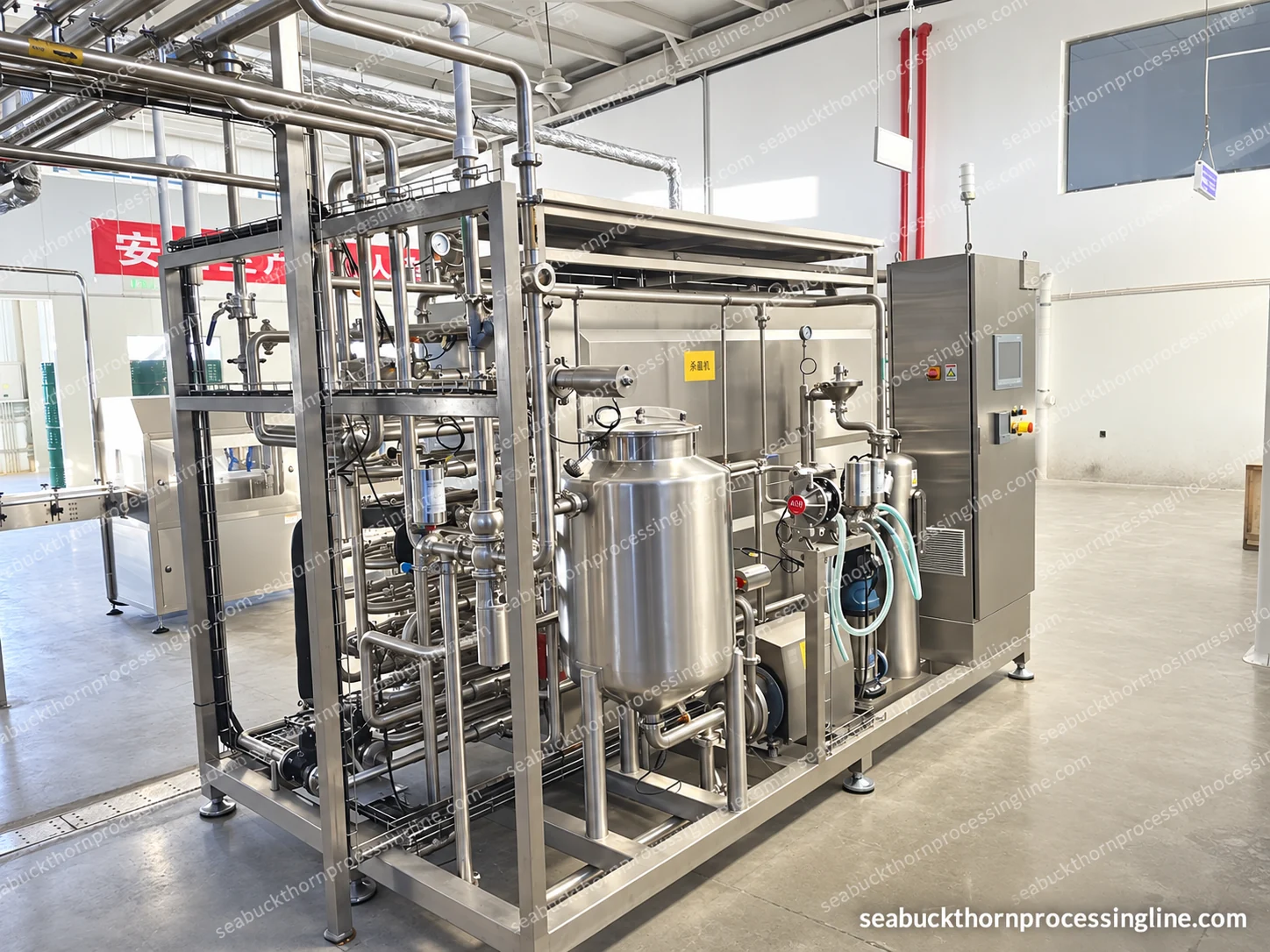
The visible skid has horizontal tube banks, a central vessel and instrumentation. Its exterior does not define every internal flow path. Confirm the product circuit, utility circuits, holding section and routing of startup or diverted material in the selected flow diagram.
Use the family range as a configuration reference
The temperature and holding ranges below describe adjustable equipment-family options. They are not a recommended sea buckthorn recipe, and they do not mean that every setting is available on every supplied configuration. A validated product process determines the required operating point.
| Item | Family reference | Application condition |
|---|---|---|
| Temperature | 72–150 °C | Choose the actual duty for product and process validation |
| Holding time | 15–120 seconds | Match holding geometry to verified product flow |
| Heating and cooling | Hot water or steam; cooling water or chilled service options | Confirm selected utilities and outlet temperature |
| Product-contact material | 304 or 316L options | Select grade and seals for product and cleaning exposure |
Make the holding condition measurable
Product flow determines residence through a given holding section. The flow measurement, temperature sensing and response to an out-of-condition event must therefore be considered together. Changing flow for a filling constraint can also change the heat-treatment condition.
Define how the line starts, when product can proceed, where unsuitable product is routed and how records are associated with the production lot. A tank-level signal alone cannot establish that the required thermal condition has been met.
Connect thermal treatment to the package route
An aseptic bag route requires a maintained hygienic boundary after the validated thermal step. The downstream pipework, filling head and package system must be integrated with the startup and cleaning sequence. Thermal treatment alone does not establish a packaged shelf life.
Provide access to the tube-bank connections, instruments, seals and valves. The cleaning circuit must reach the selected product path, and its return should be monitored separately from the heating and cooling services.
Further answers
Equipment and process questions
Can a temperature in the listed range be selected as the production recipe?
The range describes the equipment family. The required thermal schedule must come from the actual product, microbial objective, flow conditions and package process, then be validated.
Which interfaces should the thermal process diagram define?
Identify the product and utility circuits, the holding section, instruments, each vessel connection and the routes for startup, cleaning and out-of-condition product. These interfaces define how the selected configuration operates.