Define a complete route through the product side
A useful cleaning circuit has an identified supply, a route through the intended surfaces and a measured return. Branches, isolated valves and low points can retain soil even while the main return looks normal. Review those details on the actual process diagram.
Sea buckthorn residue can include pulp and oil-bearing material, so preparation and cleaning verification should reflect the product that ran through each circuit. A clarified-juice line and a pulp-rich concentrate circuit need not have identical cleaning conditions.
Distinguish cleaning functions from tank count
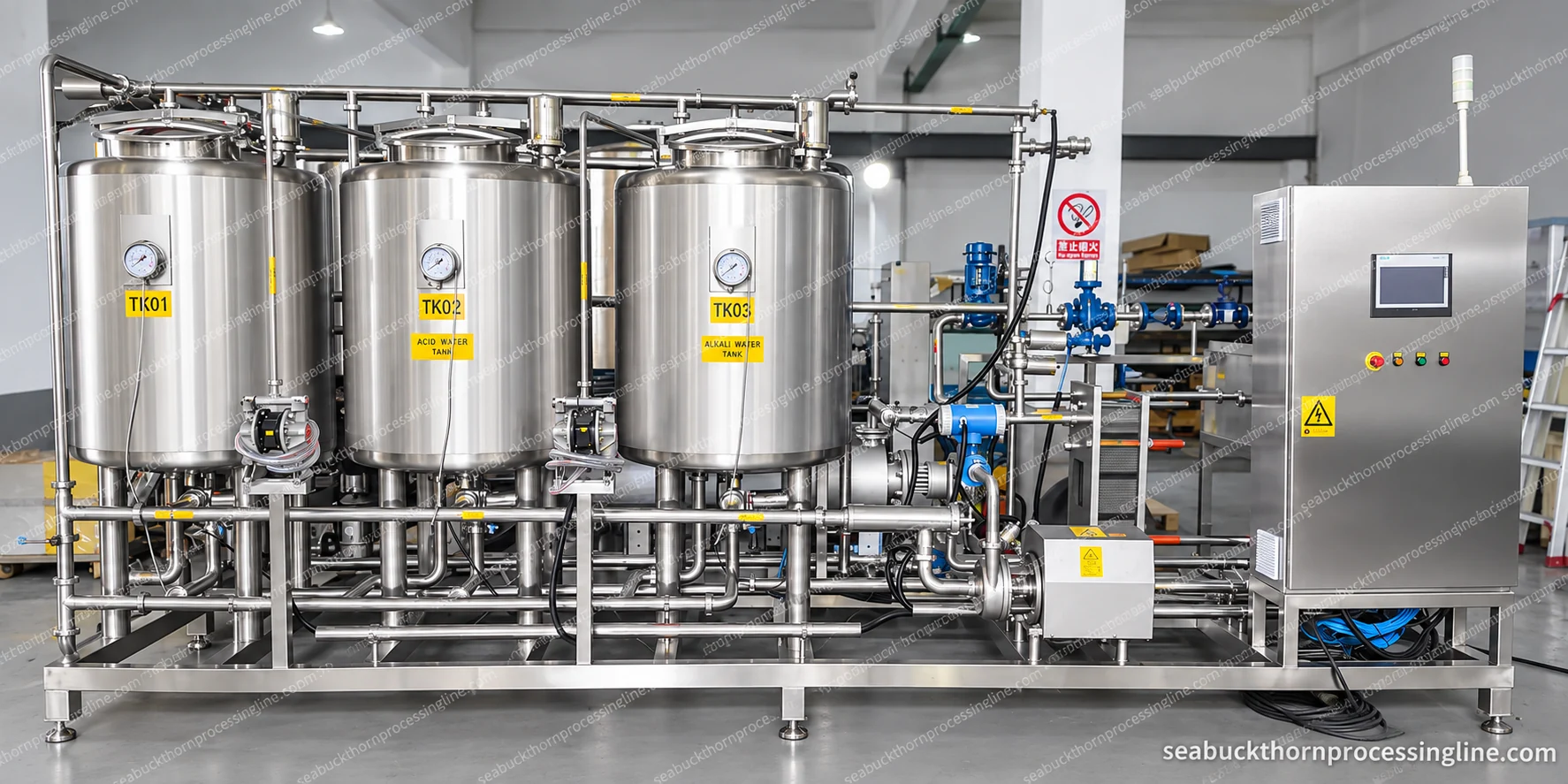
The pictured skid contains three tanks. Water, alkaline cleaning, acid cleaning and recovery describe possible functions across the equipment family; they do not prove that every function has its own separate physical tank in this image.
Select usable solution volumes, heating arrangement, transfer pumps and recovery logic around the intended circuits. Simultaneous cleaning of different areas is a separate duty from sequential circulation through one loop.
Monitor the return at the circuit that matters
| Circuit item | Why it matters | Verification point |
|---|---|---|
| Supply and return flow | Distribution through the selected path | Establish the circuit flow and return behaviour |
| Temperature and cleaning chemistry | Conditions reaching the product surfaces | Measure the relevant return and follow the agreed method |
| Drainage and final rinse | Removal of spent media and residual chemicals | Inspect drains and verify the selected endpoint |
| Circuit changeover | Separation of product and cleaning media | Check valve routing and the return-to-production sequence |
Provide separate cleaning for exposed and removable parts
Open wash belts, inspection conveyors, press cloth and accessible rollers are not automatically cleaned by a closed pipe loop. Pulper screens and separator internals require the cleaning and inspection method appropriate to their selected configuration.
Agree dismantling points, cleaning access and verification records alongside the CIP layout. No universal chemical concentration, temperature or cycle duration is assigned across the whole line.
Further answers
Equipment and process questions
Do four cleaning functions mean four tanks?
No. Cleaning functions and physical tank count are different. The illustrated skid has three tanks; the selected system defines storage, preparation and recovery routes.
Can this CIP skid clean every machine on the line?
Only the defined compatible circuits. Open belts, removable screens and certain separator or press components need their own cleaning and inspection arrangements.