Reconcile continuous machines with batch operations
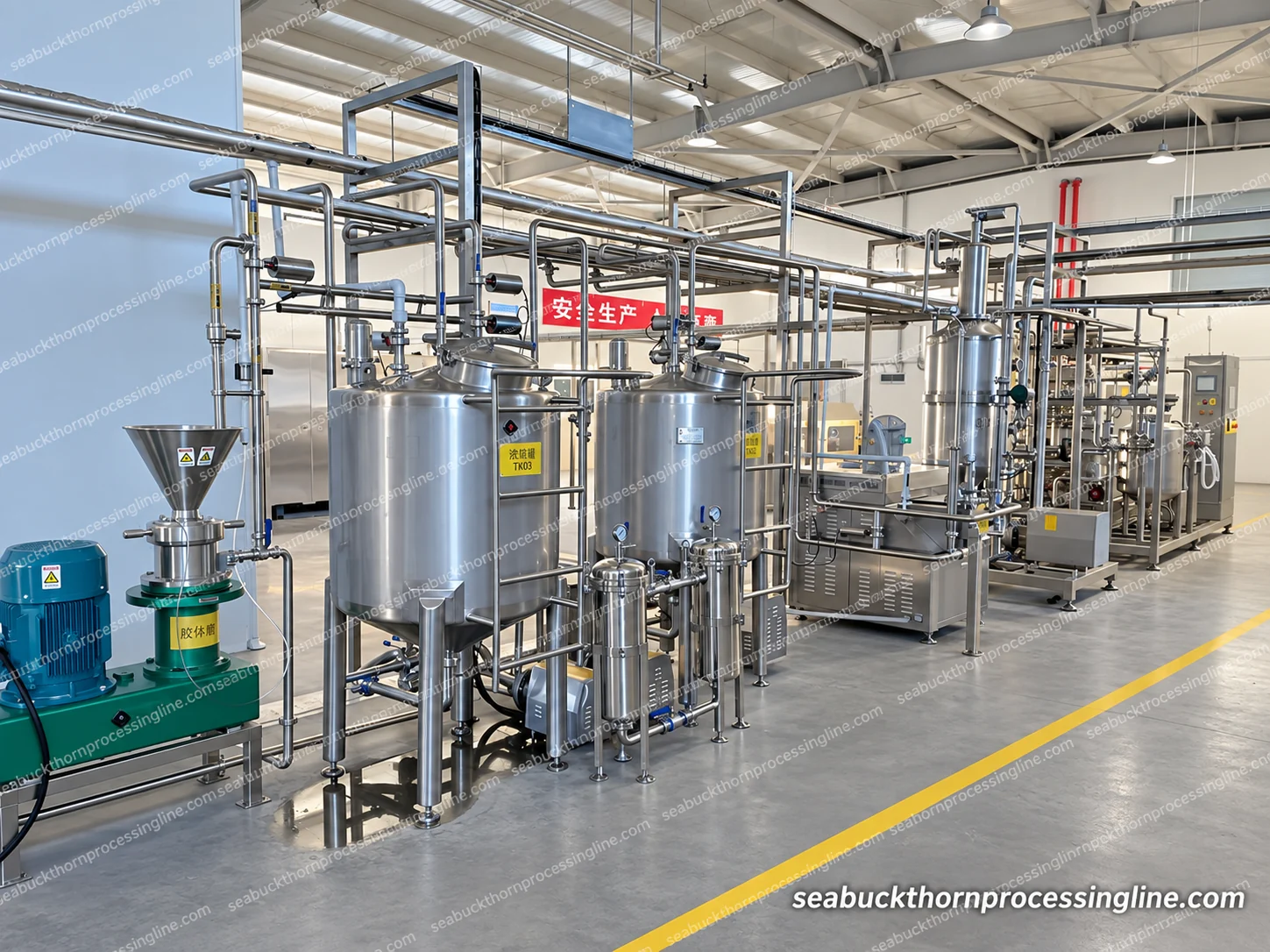
Inspection and extraction can fluctuate with fruit delivery, while a thermal system requires controlled flow. A buffer creates time for the expected mismatch. Its useful volume, mixing and level control are designed around that duty, with a defined response when the upstream or downstream section stops.
An enzyme-conditioning batch introduces another time sequence. Filling, treatment, release and cleaning must fit the production plan without sending untreated material to the next step. Package changes and separator discharges create different interruptions and should be represented separately in the operating sequence.
Locate the transfer point, reject path and service space
Open equipment interfaces specify the discharge elevation, receiving opening and control of spills or fruit escape. Closed interfaces specify the product connection, available pressure, allowable flow range and the intended isolation arrangement. Pumps need suitable inlet conditions as well as sufficient discharge capability.
Lay out reject collection and drains alongside the product path. A pulper must have room to remove a screen; a press needs access to its belts; separators require their specified service clearances. Lifting access and the route for a replaced component can influence the arrangement more than the machine footprint alone.
Tie process duties to available utilities and signals
Heat supply, cooling water, process water, electrical power and any required compressed air are scheduled by equipment and operating condition. Concentration adds vapour and condensate duties. Cleaning may require a different peak flow or heating demand from production, so the utility schedule includes both modes.
Controls coordinate levels, flow permissions and the responses to a blocked outlet, low feed or downstream stop. The thermal process requires its specified flow and temperature controls, while the filling interface needs a defined release condition. The operating sequence identifies where unsuitable product goes instead of relying on an operator to infer it from several independent panels.
Make acceptance representative of the purchase
For a complete line, the acceptance boundary begins with a defined feed and ends with an agreed product or package. For a module, it begins at the tie-in point. Record the product lot, temperatures, operating duration, flow basis and required quality measurements so that the observed rate has a usable meaning.
Functional checks establish instrumentation, alarms, interlocks and transfer operation. A representative product run addresses extraction, separation, heating and filling behaviour that a water run cannot establish. Cleaning and safe restart checks complete the operating sequence, with results recorded separately from items that require later site conditions.