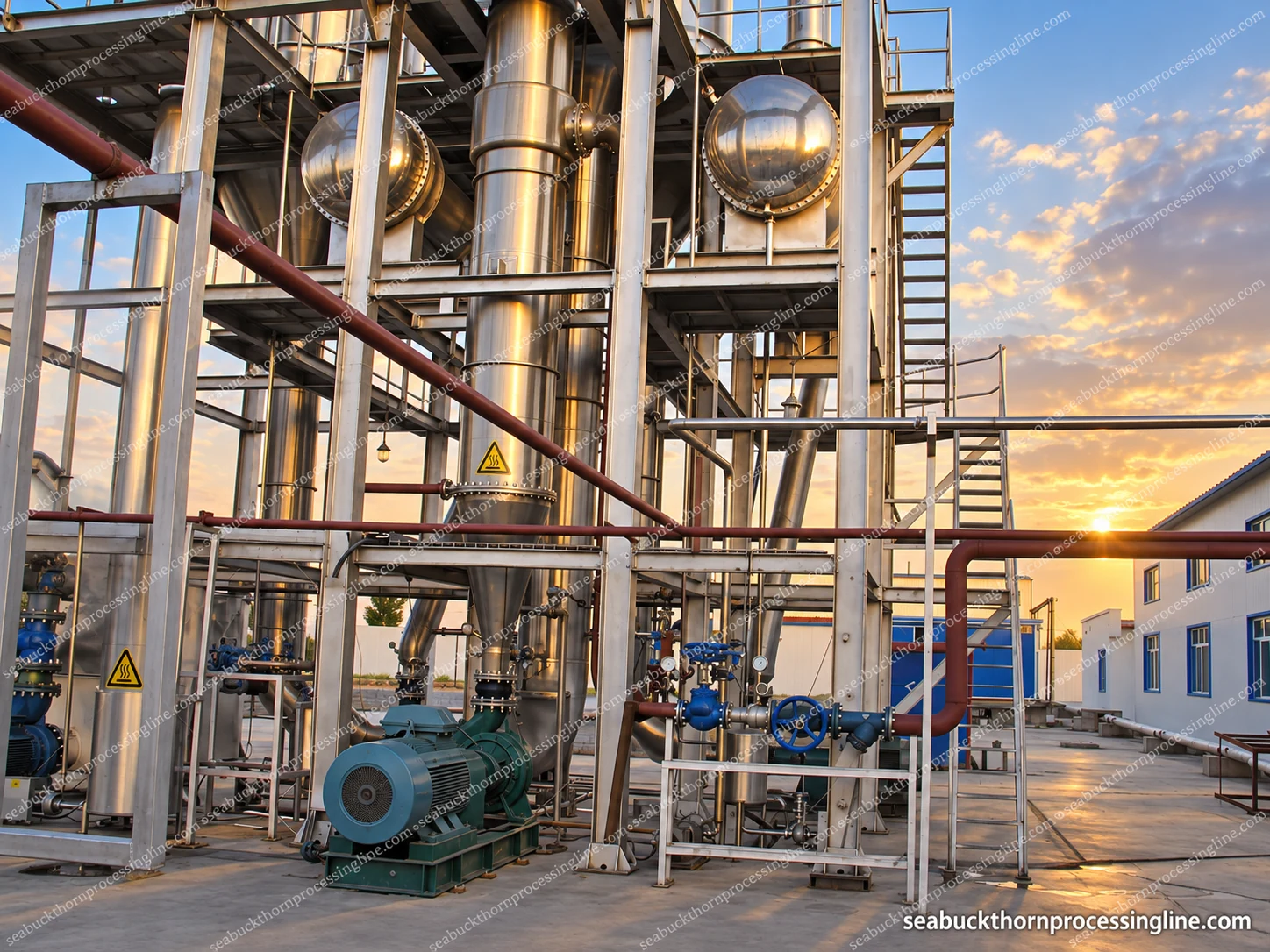
Start with the stream entering concentration
Define whether the feed retains pulp, contains a visible cream fraction or has already been clarified. Record its temperature, soluble-solids measurement and relevant viscosity data. Soluble-solids readings alone do not account for every insoluble or oil-bearing component of a sea buckthorn pulp.
Set a concentrate specification that can be measured consistently. The water-removal calculation and the downstream filling rate should use the same feed and product basis, including any separate reject or recovery streams.
Choose a heat-transfer route that remains workable
The equipment family includes falling-film and forced-circulation arrangements, with the duty selected around product behaviour. Film distribution, circulation demand and fouling should be evaluated at the intended concentration, not only at the easier dilute inlet condition.
Single- and multiple-effect arrangements are family options. The number of effects, heating arrangement and utility demand belong to the selected design; the exterior photograph does not establish an effect count or a vapour-recompression system.
Link the product balance to services and pumps
| Design input | Equipment consequence | Evidence required for selection |
|---|---|---|
| Feed and concentrate composition | Water-removal load and final product rate | Consistent mass balance with stated measurement basis |
| Viscosity and suspended material | Heat-transfer route and circulation duty | Representative feed and concentrated-product behaviour |
| Foam and fouling | Separation space, operating window and cleaning | Product trial or relevant measured operating data |
| Available heating and cooling services | Heat exchange, condensation and vacuum duty | Actual site service conditions |
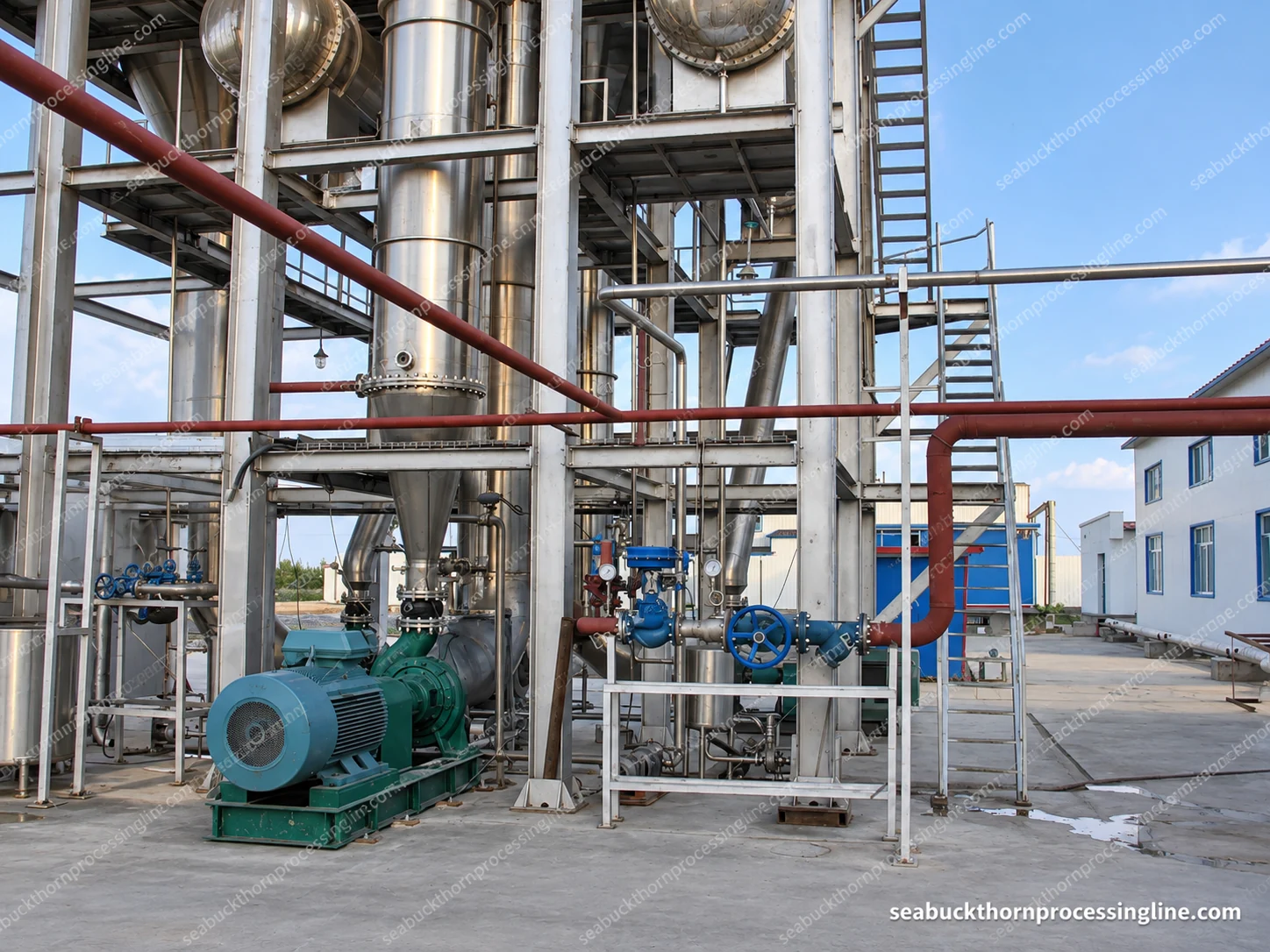
Plan the end of a run as well as steady production
As product becomes more concentrated, pumping and heat-transfer behaviour can change. Define operating limits that can be observed and a response to increasing fouling or unstable circulation. A universal concentration endpoint cannot be taken from the appearance of the machine.
Include startup product, shutdown recovery, condensate handling and cleaning return in the flow arrangement. Coordinate the concentrate outlet temperature and flow with the next thermal or filling step, so that the concentrator does not create an uncontrolled holding period.
Further answers
Equipment and process questions
Is the illustrated system rated for a specific sea buckthorn concentration?
No application-specific water-removal rate or final concentration is assigned from the photograph. The duty requires feed composition, rheology, utility conditions and the intended product endpoint.
Can the same system handle puree and clarified juice identically?
They can present different viscosity, suspended-solids and fouling conditions. Assess the heat-transfer route and circulation at the actual concentrate condition for each product.