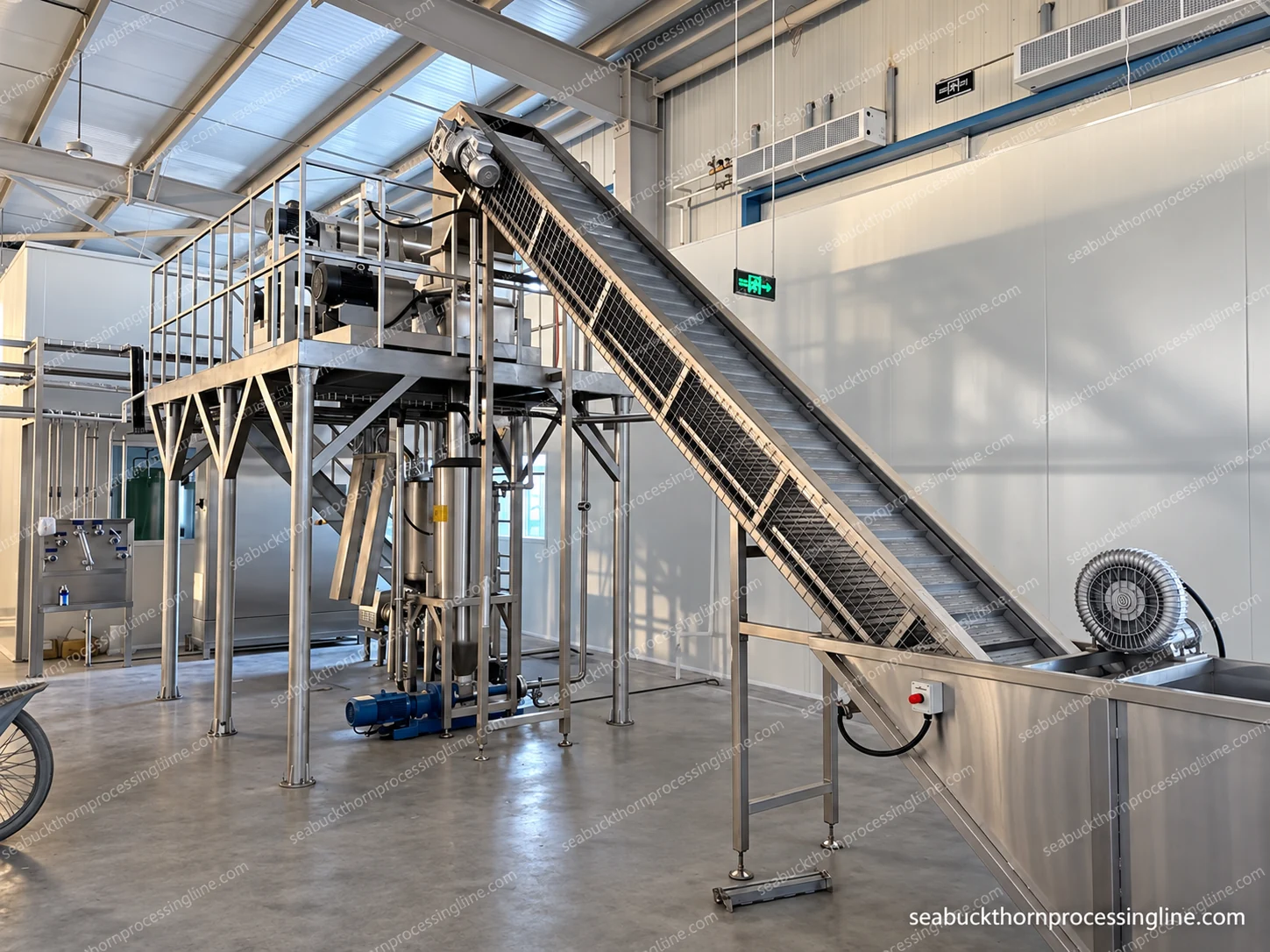
Begin with the condition of the incoming berries
Sea buckthorn receiving lots can contain clusters, detached berries, leaves and twig fragments. A wash-and-lift section should receive the fruit condition for which it has been selected. Large branches can obstruct the transfer, while berries trapped in clusters may pass through without receiving the same exposure as loose fruit.
Frozen berries need a defined preparation and temperature condition before wet handling. Frozen blocks are a separate upstream handling problem; the incline shown is not a block breaker or thawing system.
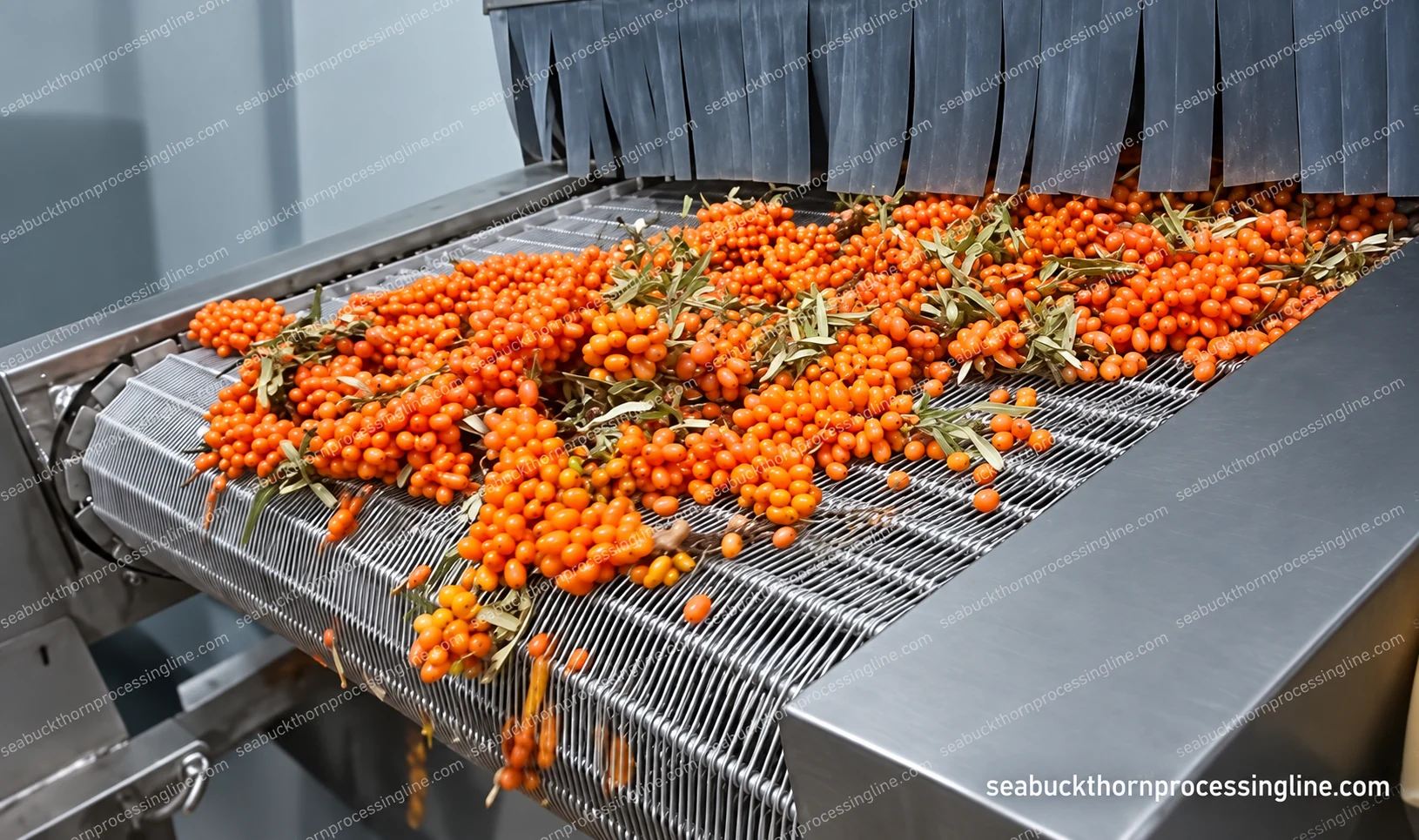
Keep the washing outlet and lift connected
The incline uses cleats to support material during elevation. Its lower end meets the partially visible wash tank, while the upper end discharges at platform height. Belt openings, side clearances and the transfer gap determine whether small berries remain on the intended route.
Drainage between washing and pulping matters because retained wash water joins the product stream. Provide a defined route for that water, clean access beneath the incline and a discharge geometry that avoids a long uncontrolled drop.
- Match the wash outlet level to the lift pickup point.
- Specify the smallest accepted berry size and the largest allowed twig fragment.
- Leave access to guards, belt return and drainage points.
Selection points for a small berry feed
| Selection point | Design consequence | Acceptance check |
|---|---|---|
| Berry size and debris | Belt surface, side containment and upstream sorting | Check fruit loss through openings and at transfers |
| Fruit temperature and firmness | Handling intensity and residence in water | Compare damage and pulp leakage before and after the section |
| Carryover water | Drain length and downstream mass balance | Measure drained water separately from product |
| Discharge height and rate | Incline geometry and feed control | Confirm stable loading of the next machine |
Drain and inspect the open handling surfaces
An open berry preparation area needs accessible belt surfaces, return runs and tank corners. Washing the closed downstream pipework does not clean these external surfaces. Remove trapped leaves and pulp before they dry around the belt edges and discharge chute.
Coordinate the water supply, solids collection, floor drainage and safe access with the site layout. The final arrangement should make the routine inspection points reachable without opening a running machine.
Further answers
Equipment and process questions
Does this assembly remove every leaf and twig automatically?
No. Upstream debris removal and the allowable incoming twig load are separate selection points. The connected wash-and-lift arrangement does not establish an automatic optical or twig-removal function.
Can existing sea buckthorn pulp enter here?
Existing pulp belongs at a hygienic receiving or process-tank connection. Sending it through an open berry washer would add an unnecessary handling step and an uncontrolled water balance.