Specify what the accepted liquid should contain
Clarification can reduce a selected suspended fraction while changing the appearance and body of the juice. That may be desirable for one product and undesirable for a cloudy juice that is intended to retain pulp. Establish the product endpoint before setting a clarification target.
A separate oil-rich layer or cream phase requires its own outlet and composition definition. A two-phase clarification arrangement cannot be assumed to provide separate oil, aqueous and solids streams. Phase configuration and demonstrated behaviour on the actual feed determine that scope.
Integrate the separator with stable feed and discharge
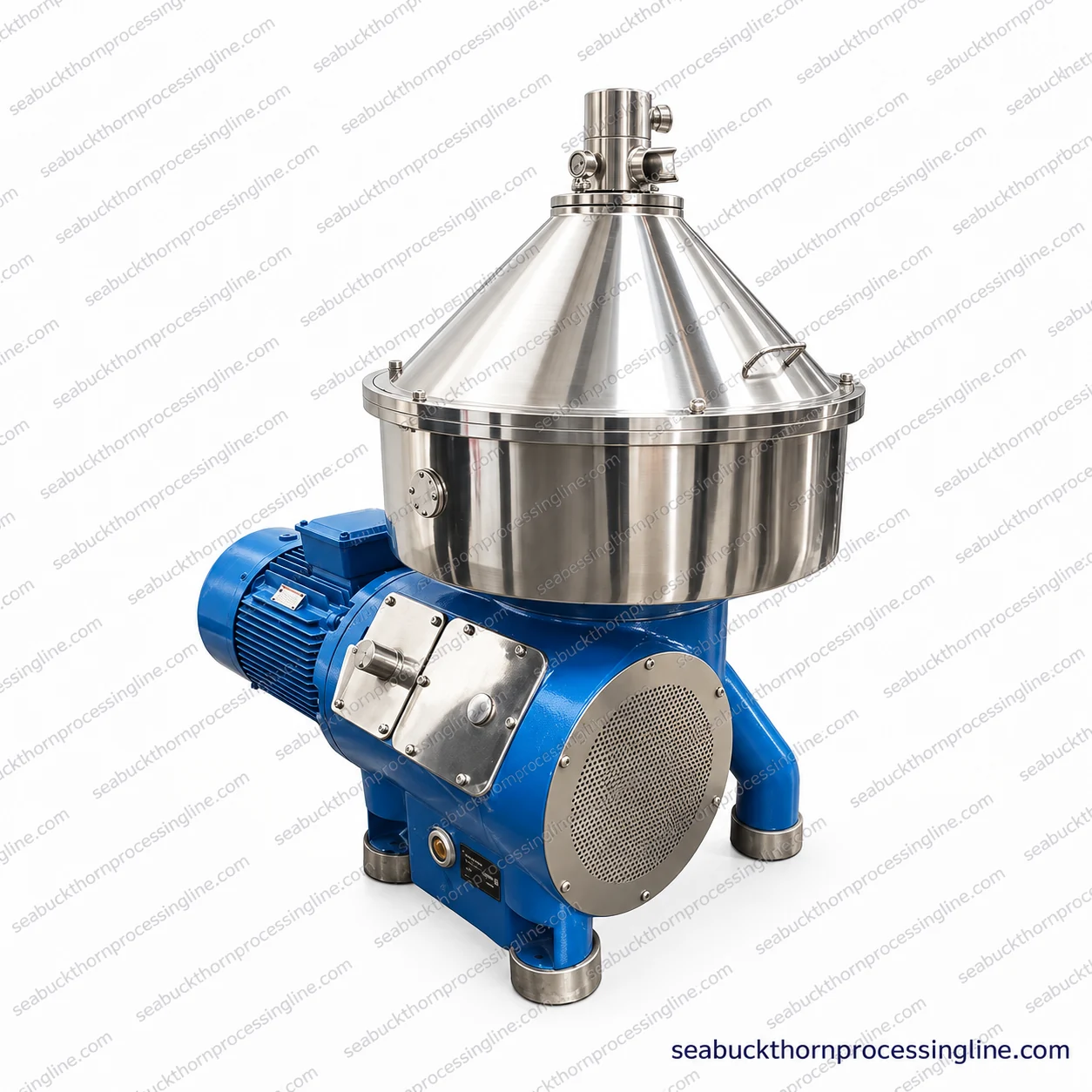
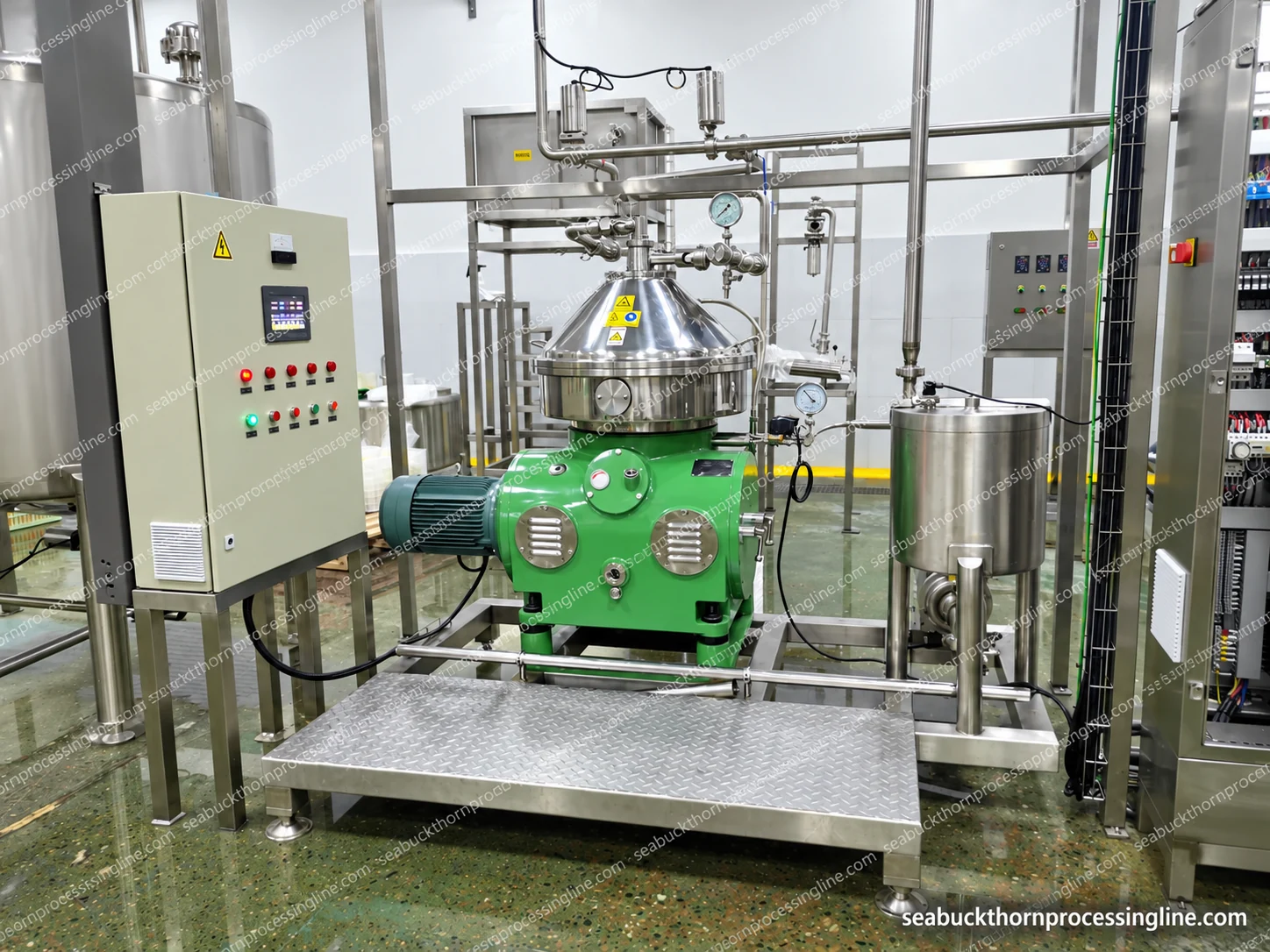
The installed reference shows a separator, an adjacent vessel, pipework, gauges and controls. This illustrates the service space and connections around a separator; the surrounding assembly is a different configuration from the blue-base product photograph.
Provide controlled feed delivery, accessible sample points and distinct collection routes. Separator operation may include intermittent solids discharge, so the reject system must accommodate that pattern without contaminating the accepted product.
Link each trial measurement to an outlet
| Trial condition | What to record | Reason |
|---|---|---|
| Inlet stream | Temperature, preparation route and suspended-solids condition | Establish a reproducible feed |
| Accepted liquid | Mass flow and the chosen clarity or pulp metric | Measure the intended product change |
| Rejected or separated fraction | Mass and composition of each actual outlet | Avoid calling all rejected material oil |
| Stored samples | Layering over a defined time and temperature | Separate natural phase behaviour from immediate clarity |
Select the bowl configuration before fixing the line duty
Bowl assembly, solids discharge and permitted feed conditions belong to the selected separator specification. No generic upper solids percentage is used as a sea buckthorn inlet allowance. Upstream decanting or screening should be justified by the load it removes and the product it preserves.
Plan access for bowl service, seals and cleaning connections. Confirm how the machine enters and leaves the cleaning sequence, including the treatment of any retained material and the safe return to product operation.
Further answers
Equipment and process questions
Does a cream layer prove the separator has failed?
Not by itself. Record the feed, separation objective and storage condition. A product may contain an oil-bearing fraction that later forms a layer even when the agreed particle-removal duty has been met.
Can the product photograph define the number of liquid phases?
No. The selected bowl, outlets and trial results must establish the phase duty. Exterior photographs are not a basis for promising three-phase recovery.