First establish what has separated
Research on freshly pressed sea buckthorn juice has reported an upper cream layer, a middle juice layer and sediment after refrigerated standing. This observation explains why a mixed sample and a sample drawn from one level can look different. It is not a universal prediction of layer sizes or a diagnosis of a machine fault.
A product can be specified for use after mixing, or for a selected degree of separation. The preparation used before sampling should match that specification. Record standing time and temperature before comparing samples; otherwise a change in how the sample was handled can be mistaken for a production change.
Manage fruit-derived oil within the juice process
Oil-rich material associated with the fruit pulp may remain dispersed, form a cream layer or enter a separated stream. The desired treatment determines whether gentle mixing, a selected separation duty or another product-conditioning step is appropriate. Removing this material changes the balance of the resulting juice.
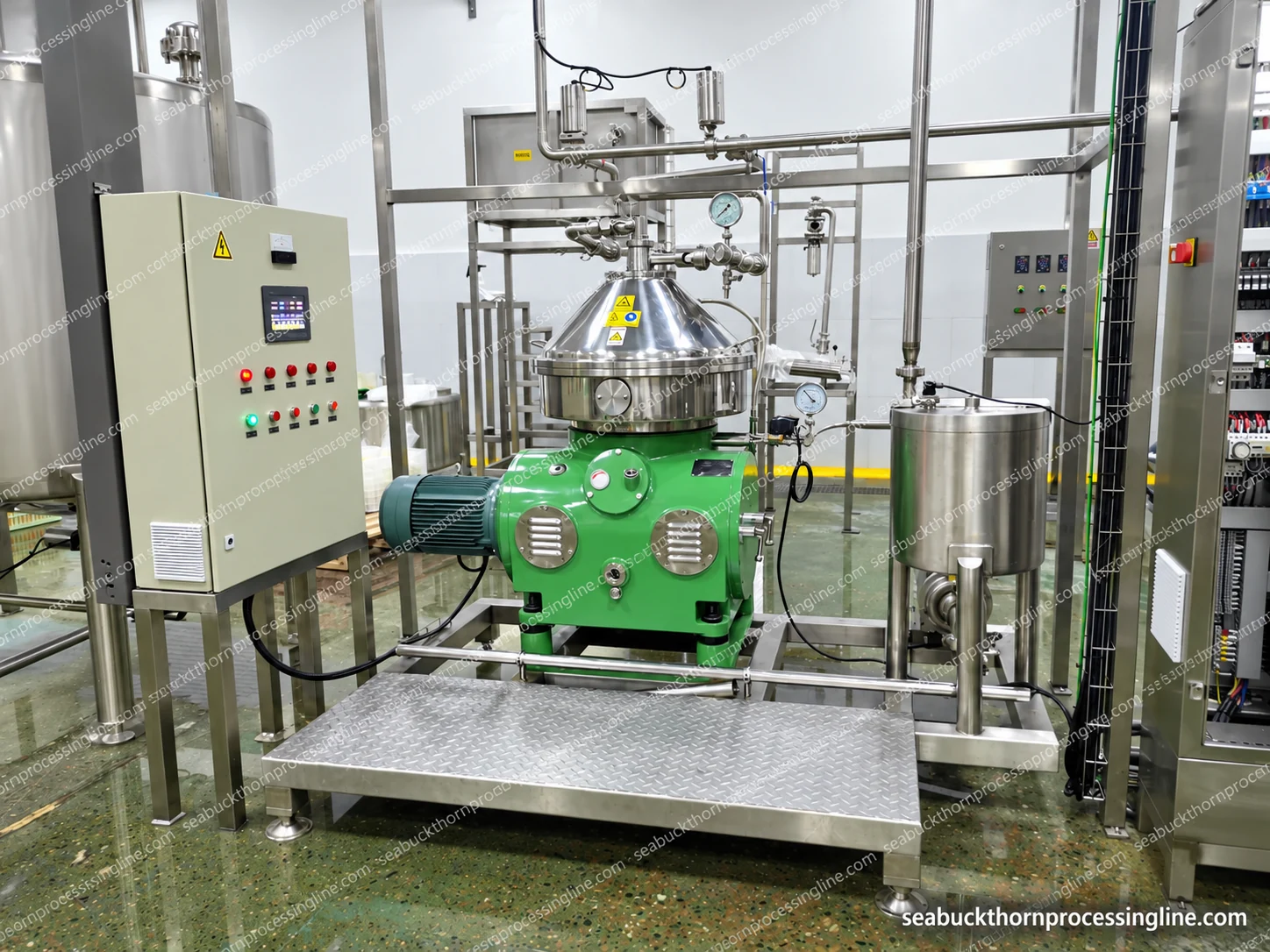
A separation duty must identify the inlet and each intended outlet. Clarifying a liquid by removing solids differs from separating two liquid phases as well as solids. The bowl configuration, outlets, interface control and feed behaviour must support the requested duty; the word centrifuge alone does not define it.
Seed oil begins with a different material stream
Seeds recovered during fruit processing are a separate by-product stream. Producing oil from that material requires suitable seed preparation and an extraction process selected for the oil-bearing tissue. Pressing juice from a wet fruit mass, clarifying a juice and extracting oil from prepared seeds are distinct operations.
When a juice project also includes seed valorisation, keep the seed collection interface separate in the process scope. Define the collected material and its destination without assigning a seed-oil recovery duty to the juice press or separator. The juice and puree equipment described here is selected for those food-ingredient processes.
Use phase behaviour as a process observation
If a product layers more quickly than expected, compare like-for-like samples before changing the machine. Review feed lot, temperature, extraction settings, holding, mixing and any enzyme treatment. Check whether the amount of retained pulp or the location of sampling changed.
A sudden change accompanied by seed fragments, abnormal discharge or unstable flow points to different checks from slow natural settling in an otherwise consistent batch. Product appearance, material balance and equipment observations should be interpreted together.