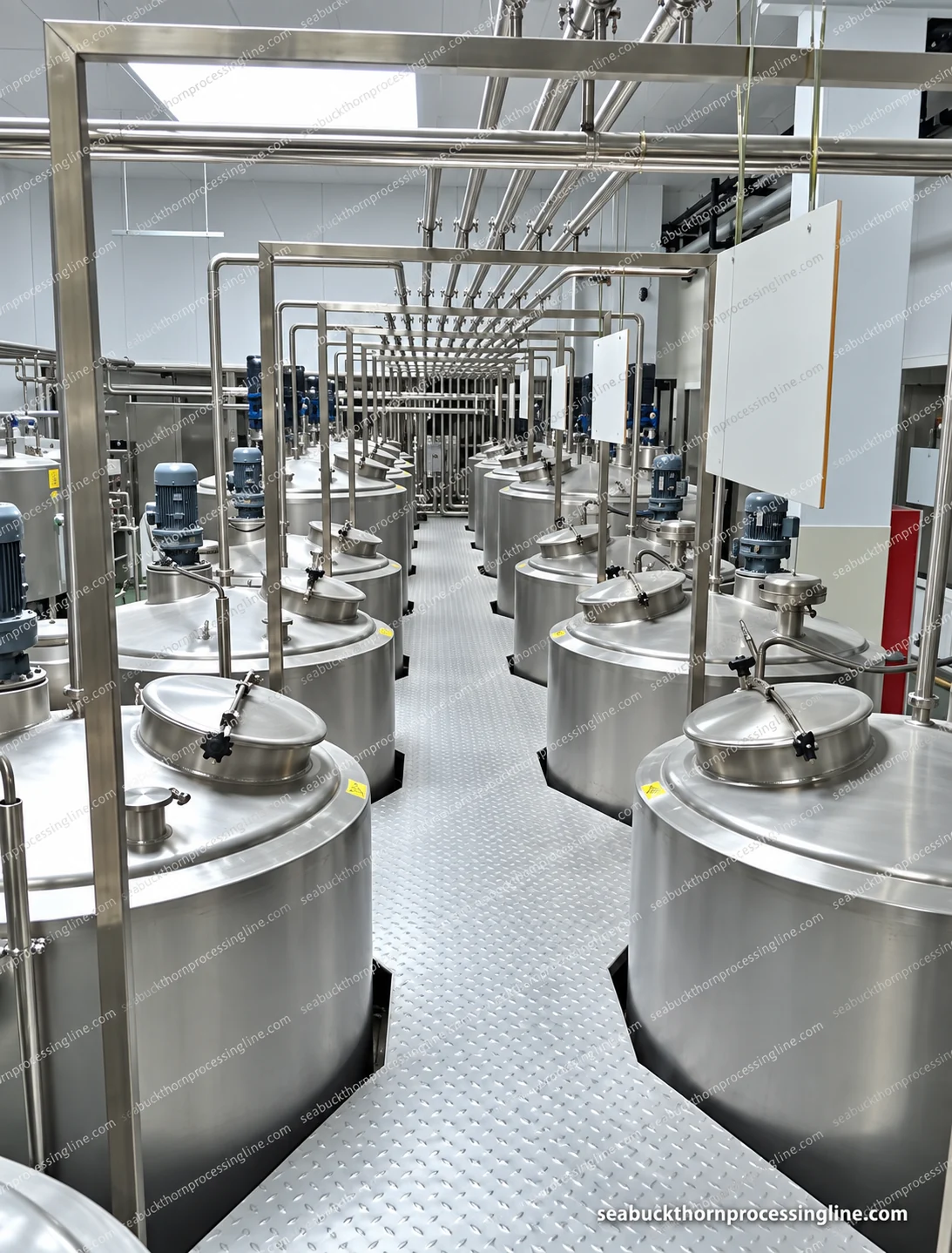
Separate buffering time from treatment time
A buffer absorbs a temporary difference between upstream and downstream flow. Its useful operating range should cover that difference without forcing excessive product residence. Tank capacity measured to the top is not the volume available between low and high operating levels.
A conditioning step requires a different assessment. If an enzyme process is selected, addition, mixing, temperature, batch identification and the end of treatment must be defined together. A continuous feed-through buffer does not by itself guarantee a minimum treatment time for every portion of product.
Keep the product uniform enough for its next step
Mixing should support the intended duty while avoiding unnecessary air pickup. Record whether the vessel receives screened puree, press juice, clarified juice or concentrate. The same liquid level can represent very different pumping and mixing requirements.
Select transfer equipment from the actual product and line resistance. Include startup, low level and cleaning operation when checking pump suction and discharge. Pipe routing should drain predictably and allow representative sampling rather than retaining isolated pockets of old product.
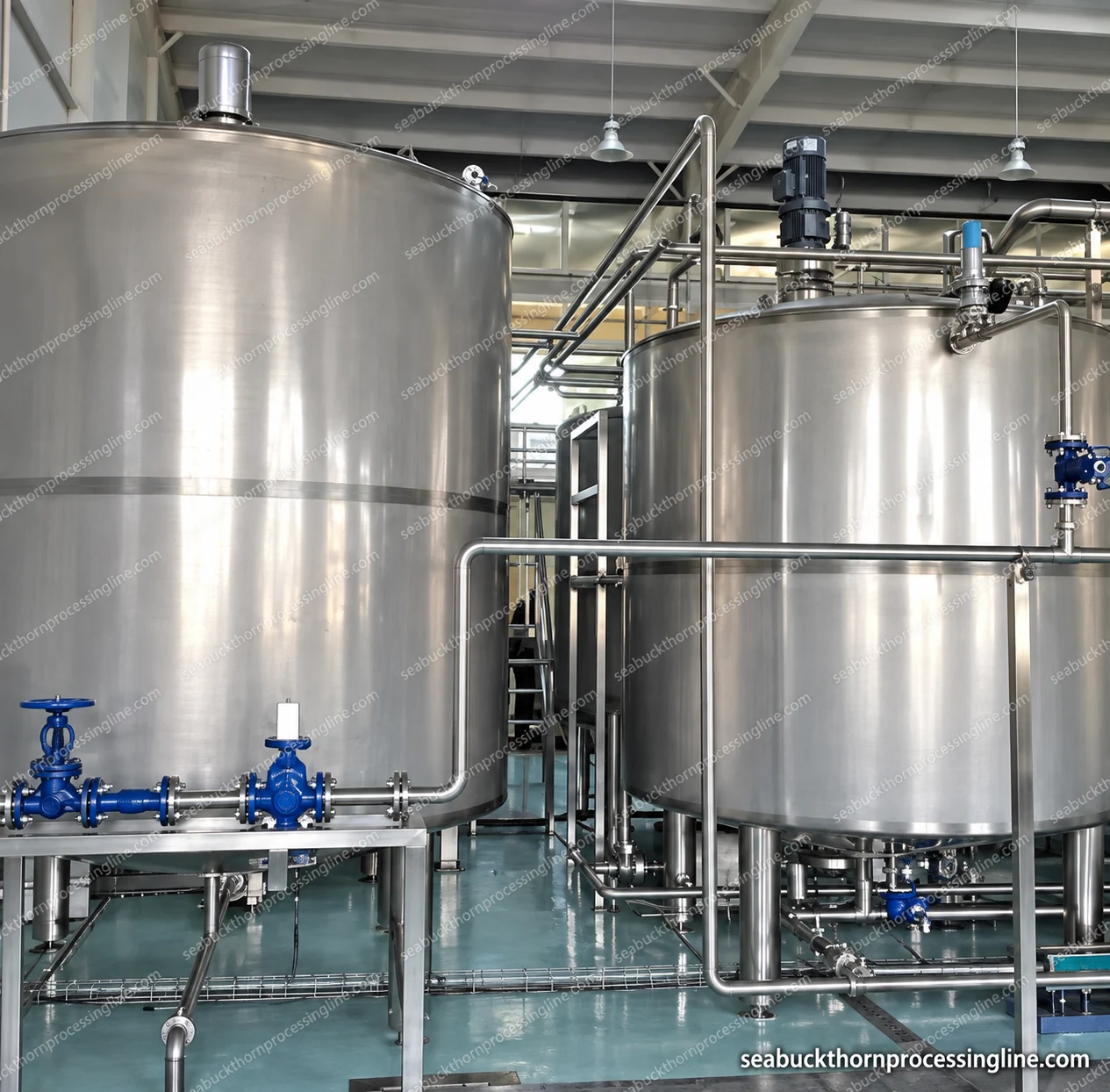
Define the vessel around its operating cycle
| Item | Buffer duty | Conditioning duty |
|---|---|---|
| Useful volume | Covers the specified flow mismatch | Supports the selected batch or residence arrangement |
| Mixing | Maintains an acceptable feed condition | Distributes additions and temperature as required |
| Instrumentation | Level and downstream-feed protection | Also records the treatment variables that define the step |
| Cleaning and release | Drained, cleaned and ready for product | Also prevents treatment carryover into the next batch |
Connect optional conditioning to the actual product route
Enzyme conditioning is a process choice, not a required operation for every sea buckthorn product. Establish its effect on the desired separation endpoint with representative pulp before assigning vessel duty. Laboratory pulp-batch findings do not define a whole-fruit line rate or an industrial treatment recipe.
Agree contact materials, seals, any required heating or cooling arrangement and access to lids and mixers. The pictured exteriors do not establish jacket construction, internal impeller geometry or working volume.
Further answers
Equipment and process questions
Must a sea buckthorn line include an enzyme tank?
No. Conditioning is included only where its demonstrated effect supports the chosen product. A buffer or blending vessel can be specified without an enzyme duty.
Can tank capacity set the enzyme holding time?
Only after useful volume, batch or continuous operation, mixing and the actual residence pattern are defined. Dividing nominal tank volume by average flow does not prove a minimum hold for every portion.