Begin with the required change in the juice
Pectin-related viscosity and suspended material can affect separation. Sea buckthorn studies have investigated enzymes for changes in viscosity and juice separation. The useful industrial question is the intended change in the product: a clearer stream, a different filtration load or another defined condition.
A puree intended to retain body does not automatically benefit from the same treatment as clarified juice. The extraction method and the solids already removed also affect the conditioning feed. Establish the desired endpoint before adding a tank residence step to the line.
The tank must control the batch, not just contain it
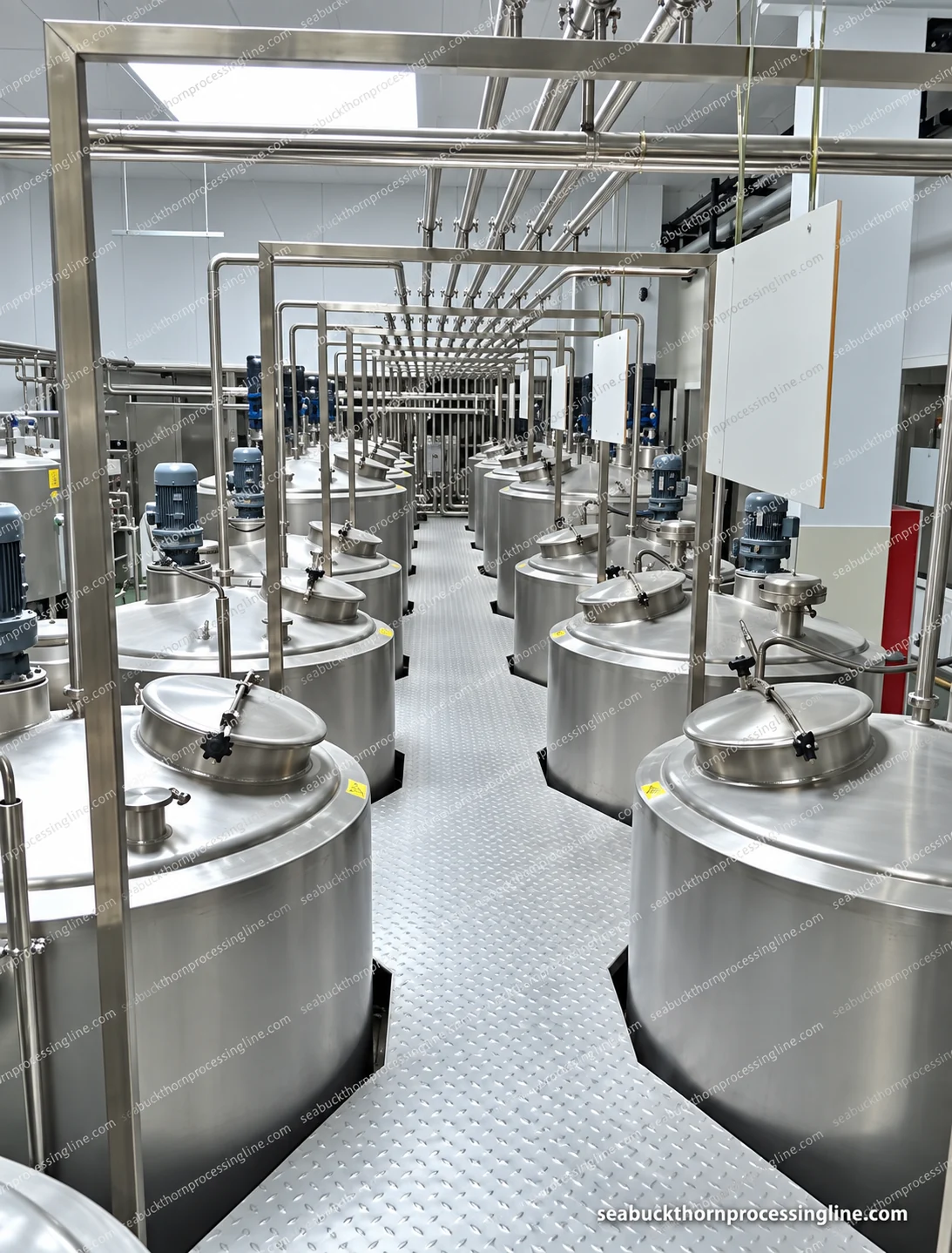
A conditioning vessel needs an appropriate useful volume, a defined method of adding and distributing the treatment, and temperature measurement representative of the product. Mixing must achieve the intended distribution without excessive air entrainment. Tank discharge and the next machine must accommodate the treated material.
Batch residence and continuous-line output must be reconciled. If one tank is filling while another is completing treatment, the transfer sequence needs clear permissives and identification. A nominal tank volume divided by average flow does not prove that every part of the product has received the same treatment.
Coordinate treatment, inactivation and separation
Enzyme activity can continue beyond the intended conditioning step unless the process controls it. The chosen treatment therefore includes its endpoint and, where required, inactivation before the downstream product is collected. That purpose is distinct from validation of the final microbial heat process.
The separator receives a stream at a defined temperature and flow. Any conditioning-induced change in viscosity or phase behaviour affects the duty. Follow product and reject streams during a trial rather than judging performance by the appearance of a single clarified sample.
Scale the observations, not a laboratory recipe
Published pectinase work used small pulp batches and laboratory centrifugation to assess juice recovery. Such measurements show treatment effects under the experiment conditions; their pulp-based recovery is not a whole-berry line yield. Laboratory rotor settings also do not specify an industrial separator.
A practical development run defines the actual feed, required output, treatment sequence and acceptance measurements. The resulting industrial scope includes dosing, mixing, time control, thermal duties, separator feed and cleaning. Temperature, enzyme dose and residence are established for that process rather than copied as universal settings.