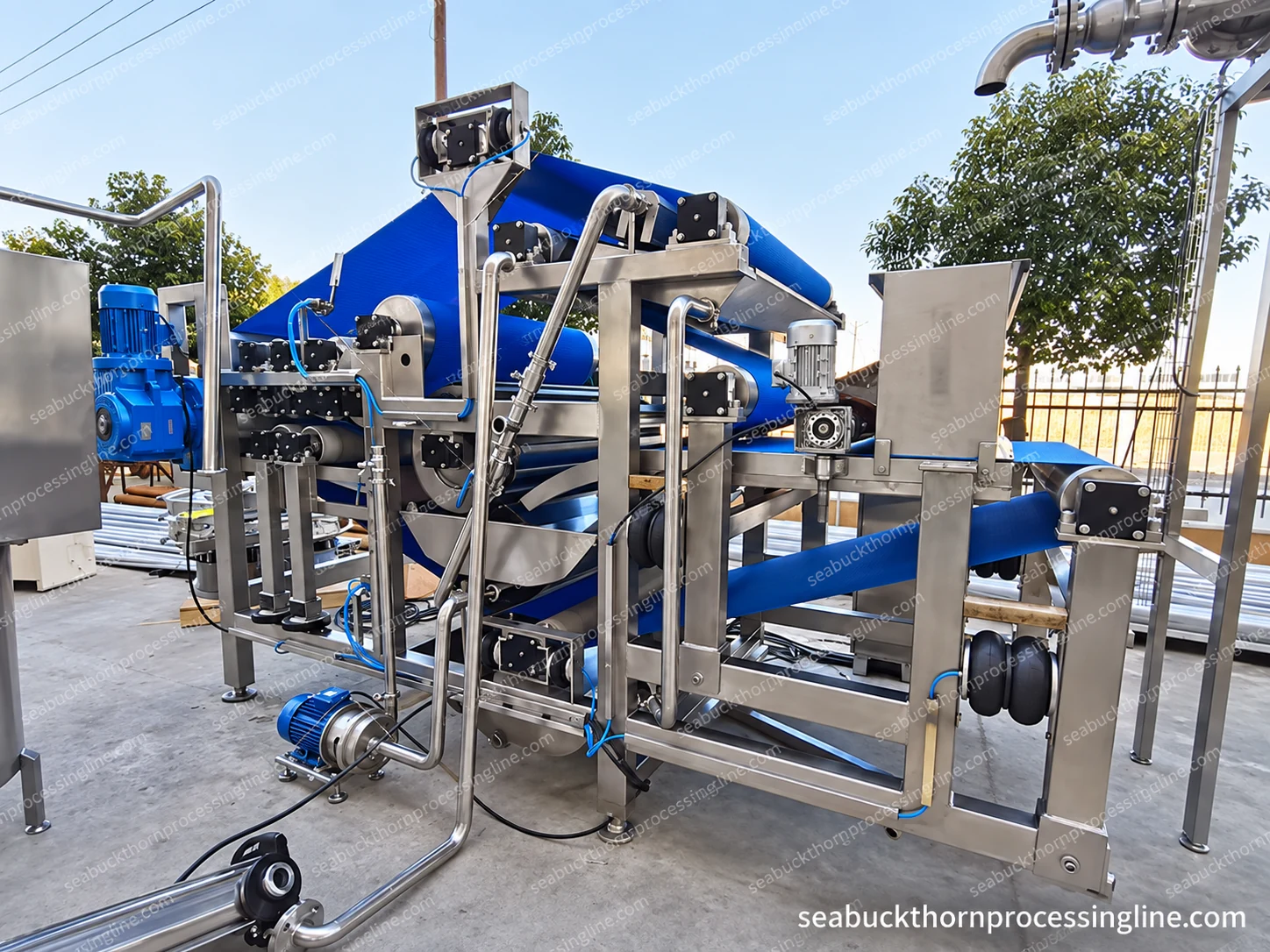
Develop a feed layer that drains
The press receives a prepared fruit feed distributed across the belt. Liquid drains during the early section and further pressure removes additional liquid through the belt as the cake travels over successive rollers. Uneven feed thickness can cause local overloading and leave under-pressed areas.
Berry condition and upstream treatment determine whether the layer drains or smears. Frozen-feed preparation, released pulp and any conditioning step must therefore be included in the press trial. The photographed machine is a fruit belt press, not a seed-oil expeller.
Choose the press around the whole discharge system
| Duty point | Selection consequence | Trial record |
|---|---|---|
| Feed structure | Layer formation and belt retention | Feed preparation, temperature and visible drainage |
| Belt loading and speed | Residence through the pressing path | Distribution across width and output stability |
| Pressure progression | Cake moisture and seed condition | Juice sample, cake sample and broken-seed observations |
| Belt washing | Water demand and wastewater solids | Wash flow and drainage kept separate from collected juice |
Follow both juice and cake after pressing
Collected press juice can retain suspended pulp and an oil-bearing fraction. Pressing does not automatically produce a clear or storage-stable beverage. Decide whether the next operation retains cloud, removes settling solids or evaluates additional clarification.
Weigh wet cake as a separate stream and record any wash or dilution water. A whole-berry juice yield cannot be substituted with a laboratory figure measured from prepared pulp. If seeds are later collected from the cake, their recovery and further processing require a separate handling specification.
Plan access to belts, rollers and collection channels
Belt tracking, tension and cleanliness affect the consistency of the press. Leave access along the belt return, roller assemblies and juice collection area. A closed-pipe CIP supply does not establish cleaning coverage for exposed press belts.
The installation should separate collected juice from belt-wash drainage and provide a route for cake removal without crossing the clean downstream transfer area. Include consumable belt specifications and inspection points in the operating handover.
Further answers
Equipment and process questions
Is pressing mandatory for a screened puree line?
No. A puree route can center on the two-stage pulper and finisher. A press is a different extraction choice and should be selected because its liquid and cake outputs suit the product plan.
Is a juice recovery percentage specified?
No fixed sea buckthorn recovery is assigned. A representative trial must include the feed basis, any added water, juice mass, wet cake and the quality of the accepted liquid.