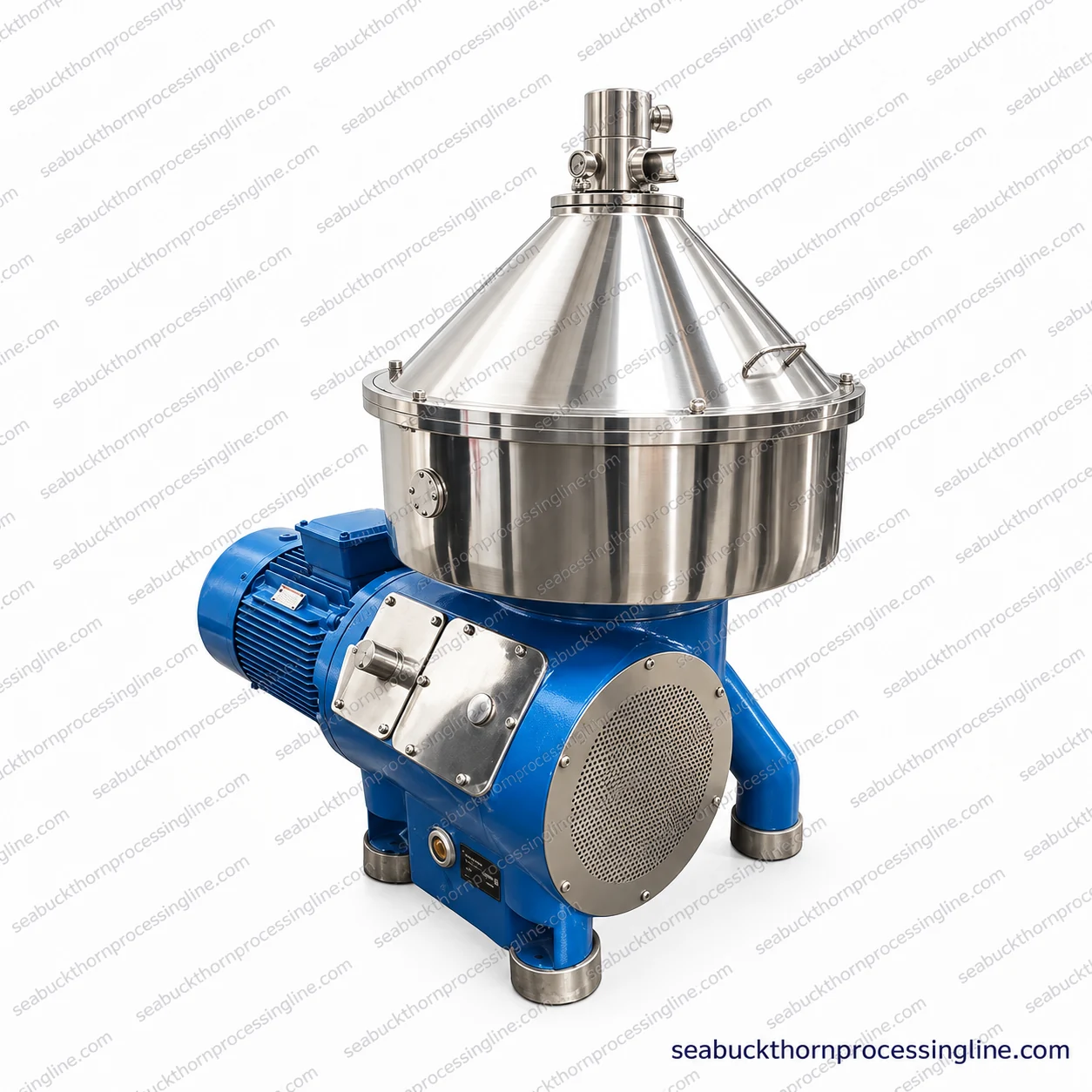
Compare mechanisms at their product and reject outlets
| Machine | How it separates | Selection consequence |
|---|---|---|
| Two-stage pulper and finisher | Pulp passes perforated screens; retained coarse matter exits separately | Controls screened texture and seed, skin and coarse-fibre carryover |
| Belt press | A prepared feed is compressed between moving belts and rollers | Produces expressed liquid and a press cake; feed distribution and drainage matter |
| Decanter | Centrifugal settling with a differential scroll discharging solids | Requires a feed whose settleable solids and viscosity fit the selected duty |
| Disc separator | Short separating paths within a rotating disc stack | Matches finer clarification or a specifically configured phase-separation duty |
A puree specification protects the material you want to retain
Screened puree is normally assessed for consistency, coarse particles and unwanted seed or skin fragments. Passing a finer screen can change the retained texture and the amount of pulp discharged with rejects. It does not make the product equivalent to clarified juice.
The combined pulper has two processing stages in one machine. Select their work together so that the second stage receives a manageable stream. Inspect wear, screen condition and the reject outlet as well as the accepted product when a change in texture or recovery appears.
A juice specification sets the clarification endpoint
A cloudy juice can deliberately retain suspended material. A more clarified juice needs a defined measurement of residual solids or appearance, taken after an agreed sample preparation. Removing additional pulp to reach a lower apparent turbidity also changes the ingredient mass and composition.
A decanter followed by a disc separator is one possible division of coarse and finer duties, not a mandatory pair. Feeding a fine-clarification stage with excessive coarse material may shorten a run or overload discharge. Conversely, a well-prepared extraction stream may not need every available separation stage.
Evaluate all streams before choosing a setting
Collect representative inlet, product and reject samples under stable operation. Record temperature and flow, then compare seed fragments, suspended matter, viscosity and material left with the reject. For a separator, include discharge events in the mass record rather than measuring only the clear outlet between discharges.
Where an oil-rich layer is present, use a defined mixing or settling protocol so that successive samples represent the same product. A two-phase clarification arrangement and a three-phase separation arrangement have different outlet functions; the desired phase split must be supported by the selected machine configuration.